
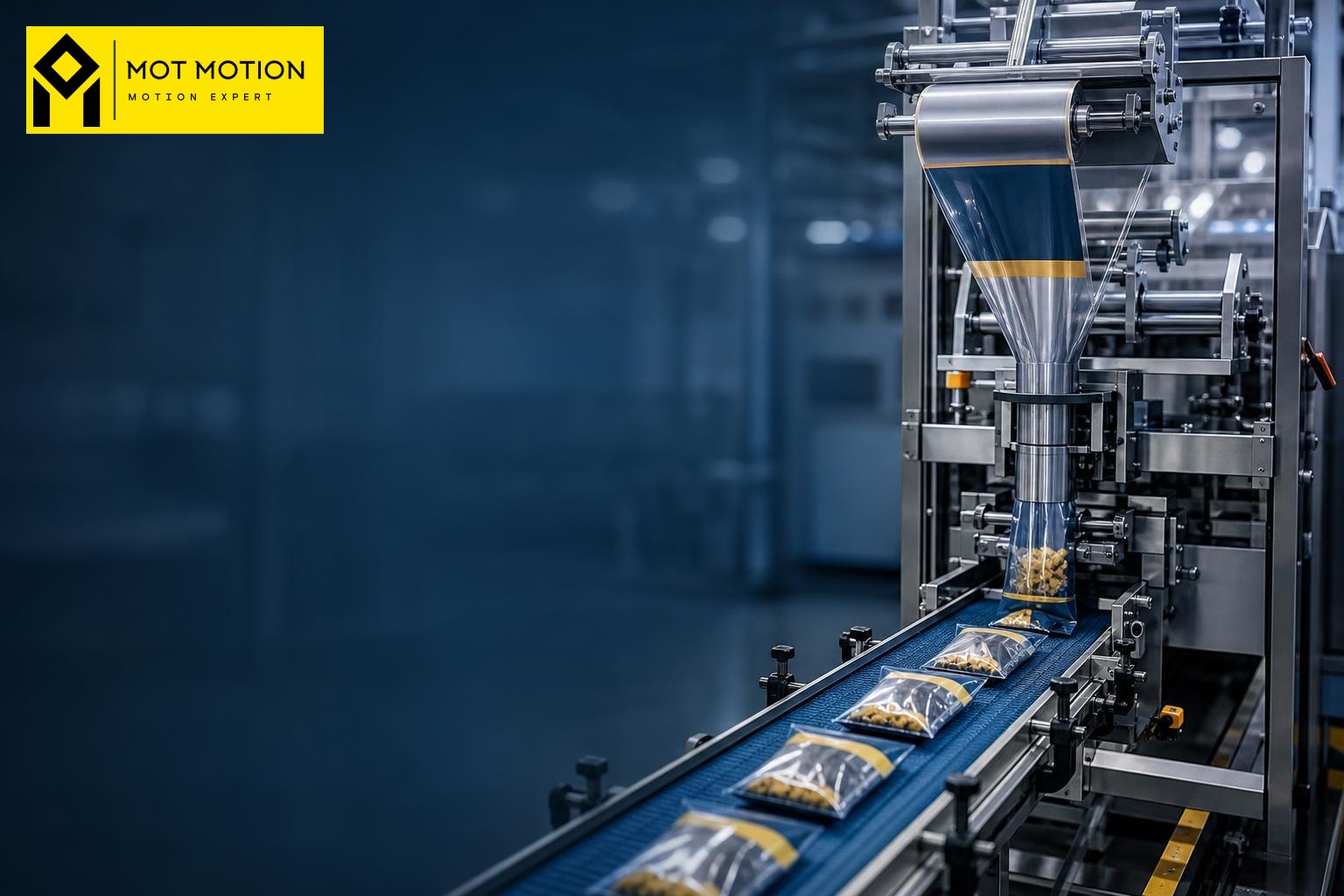
Paketleme Hattı Senkronizasyonu ve Çevrim Kararlılığı
Paketleme hattı senkronizasyonu, modern paketleme makinelerinde üretim kalitesini doğrudan belirleyen en kritik konulardan biridir. Hızlı çalışan eksenler tek başına yeterli değildir; esas başarı, film çekme, ürün besleme, form verme, yapıştırma ve kesme hareketlerinin aynı çevrim içinde kararlı biçimde birlikte çalışmasıdır. Trio motion controller tabanlı mimarilerde bu yapı, PLC mantığından ayrıştırılmış deterministik hareket yönetimiyle ele alınır ve özellikle yatay ile dikey paketleme hatlarında çevrim kararlılığına güçlü katkı sağlar.
Paketleme hattı senkronizasyonu neden kritik?
Paketleme hattında küçük görünen zamanlama farkları, sahada çoğu zaman büyük sonuçlar doğurur. Film çekme ekseni ürünü milisaniyeler düzeyinde erken ya da geç yakalarsa, yapıştırma bölgesi kayar; kesici hareket zamanlaması kaçarsa fire artar, sıkışma oluşur veya paket dikişi hatalı çıkar. Bu nedenle paketleme hattı senkronizasyonu, yalnızca eksenlerin aynı anda hareket etmesi değil, çevrim boyunca doğru noktada doğru profili izlemesi anlamına gelir.
Burada önemli olan sadece nominal hız değildir. İvme, yavaşlama, geçiş anındaki senkron davranış ve eksenler arası faz uyumu da aynı derecede önem taşır. Özellikle ürün boyu değişkenliği, film gerginliği ve mekanik boşluklar birlikte oluştuğunda, kontrol mimarisinin deterministik davranması gerekir.
Trio motion controller ile deterministik hareket yönetimi
Trio motion controller, paketleme hatlarında hareketi PLC döngüsünden ayrı bir kontrol katmanı olarak yönetmeye uygundur. Bu yaklaşım, eksenlerin yalnızca komut almasını değil, çevrim içindeki zamanlamanın da tutarlı şekilde korunmasını sağlar. Sonuçta besleme, form verme, yapıştırma ve kesme hareketleri arasındaki koordinasyon daha stabil hale gelir.
Bu mimarinin çevrim kararlılığına etkileri
- Daha düşük çevrim sapması: Eksenler arasındaki gecikmeler daha iyi kontrol edilir.
- Daha az fire: Paket konumu ve kesme anı daha tutarlı hale gelir.
- Daha az ayar ihtiyacı: Operatör müdahalesi ve yeniden tuning ihtiyacı azalır.
- Daha öngörülebilir üretim: Seri üretimde çevrim davranışı daha tekrar edilebilir olur.
Bu noktada Trio motion controller, eksen senkronizasyonunun omurgasını oluştururken, sürücü ve motor tarafında Schneider Electric veya Sanyo Denki çözümleri, uygulamanın gereksinimlerine göre seçilebilir. Redüktör tarafında ise Neugart gibi bileşenler, tork aktarımı ve mekanik uyum açısından önemli rol oynar.
Yatay ve dikey paketleme makinelerinde senkronizasyon farkı
Yatay ve dikey paketleme makineleri aynı prensibe dayanır; ancak yük yapısı, eksen dizilimi ve çevrim davranışı açısından farklı zorluklar içerir. Yatay paketleme hatlarında ürün besleme, film çekme ve kesme bölgesi çoğu zaman daha sıkı zamanlama ister. Dikey paketleme hatlarında ise ürün akışı, düşey hareket ve torba formunun korunması, senkron yapının hassasiyetini artırır.
Her iki makine tipinde de kritik nokta şudur: eksenleri sadece hız parametresiyle değerlendirmek yeterli değildir. Geçiş anındaki ivme profilleri uyumlu değilse, en güçlü servo sistem bile çevrim kararlılığını tek başına garanti edemez.
Sahada dikkat edilmesi gereken üç unsur
- Mekanik boşluk: Backlash ve bağlantı esnemeleri senkronu bozabilir.
- Sensör gecikmesi: Algılama anındaki gecikme, çevrimin tamamına yayılır.
- Ürün varyasyonu: Farklı paket boyları ve ağırlıklar çevrim davranışını değiştirir.
Bu unsurlar birlikte ele alınmadığında, kontrol sistemi kağıt üzerinde doğru görünse de sahada dikiş kayması, sıkışma veya yanlış kesim gibi sonuçlar ortaya çıkabilir.
Pratik seçim ipucu: eksenleri hızla değil, geçiş uyumuyla değerlendirin
Sahada en değerli pratik ipuçlarından biri, eksenleri yalnızca maksimum hızlarına göre seçmemektir. Asıl önemli olan, eksenlerin ivmelenme ve frenleme geçişlerinde birbirine ne kadar uyumlu davrandığıdır. Özellikle film çekme ekseni ile kesici eksen arasındaki faz ilişkisi doğru kurulmazsa, çevrim kararlılığı kısa sürede bozulur.
Bir uygulama tasarlanırken şu soruların birlikte değerlendirilmesi gerekir:
- Besleme ekseni ile form verme ekseni aynı çevrim mantığında mı çalışıyor?
- Kesme hareketi, film gerginliğindeki değişimi tolere edebiliyor mu?
- Sensör geri bildirimi kontrol çevrimine yeterince hızlı ve kararlı giriyor mu?
- Mekanik yapı, kontrol tarafındaki hassasiyeti destekliyor mu?
Bu soruların cevabı doğru kurgulandığında, paketleme hattı daha sessiz, daha stabil ve daha öngörülebilir çalışır. Trio motion controller burada yalnızca eksenleri sürmekle kalmaz; tüm çevrimi aynı ritimde tutan ana kontrol katmanı olarak görev yapar.
Sonuç: kararlı çevrim, daha az fire, daha yüksek verim
Paketleme hattı senkronizasyonu, yüksek hızdan önce doğru zamanlamayı gerektirir. Trio motion controller ile kurulan deterministik yapı, yatay ve dikey paketleme makinelerinde eksenler arası senkronu güçlendirir, çevrim kararlılığını artırır ve üretimde öngörülebilirlik sağlar. Doğru sürücü, motor ve redüktör seçimiyle birleştiğinde sonuç; daha az ayar ihtiyacı, daha az fire ve daha istikrarlı bir üretim akışıdır.
English summary: In packaging machines, true performance comes from stable synchronization, not just axis speed. Trio motion controller-based architectures help maintain cycle stability across feeding, forming, sealing, and cutting operations, reducing scrap and improving repeatability.
İletişim: Projeniz için destek almak isterseniz https://www.motmotion.com adresini ziyaret edebilir, info@motmotion.com üzerinden bize yazabilir veya +90 544 977 58 99 numarasından ulaşabilirsiniz.
English Version
Packaging line synchronization is one of the most critical factors determining performance in modern packaging machines. What truly matters is not whether each axis can move fast enough, but whether film feed, product infeed, forming, sealing, and cutting remain stably synchronized within the same cycle. In a Trio motion controller-based architecture, this coordination is handled through deterministic motion control rather than a general PLC logic approach, which significantly improves cycle stability in both horizontal and vertical packaging lines.
Why packaging line synchronization matters
In packaging applications, even small timing deviations can create major production issues. If the film feed axis arrives a few milliseconds too early or too late, the sealing position shifts. If the cutter motion is not aligned properly, scrap increases, jams occur, or seal quality suffers. For this reason, packaging line synchronization is not simply about moving axes together; it is about keeping the correct motion profile at the correct point in the cycle.
Speed alone is never the full story. Acceleration, deceleration, transition behavior, and phase alignment between axes are equally important. When product variation, film tension, and mechanical backlash are present together, the control system must remain deterministic to preserve stable production.
Deterministic motion control with Trio
A Trio motion controller is well suited for packaging lines because it manages motion as a dedicated control layer, separate from the PLC cycle. This architecture does not merely issue axis commands; it also maintains timing consistency throughout the cycle. As a result, coordination between feeding, forming, sealing, and cutting becomes more stable and repeatable.
Impact on cycle stability
- Lower cycle deviation: Delays between axes can be managed more precisely.
- Less scrap: Package position and cutting timing remain more consistent.
- Less tuning effort: Operator intervention and re-tuning needs are reduced.
- More predictable production: Cycle behavior becomes more repeatable in serial production.
In this structure, the Trio motion controller forms the backbone of synchronization, while drive and motor solutions such as Schneider Electric or Sanyo Denki can be selected according to the application needs. On the gearbox side, components such as Neugart may play an important role in torque transmission and mechanical compatibility.
Horizontal and vertical machines: different synchronization challenges
Horizontal and vertical packaging machines follow the same principle, but they introduce different mechanical and timing challenges. In horizontal packaging lines, product infeed, film feed, and cutting often require tighter timing. In vertical packaging lines, product flow, vertical motion, and bag formation place even greater demands on synchronization accuracy.
In both cases, the key point is the same: it is not enough to evaluate axes only by speed. If acceleration profiles do not match during transitions, even the best servo system cannot guarantee cycle stability on its own.
Three practical factors to watch in the field
- Mechanical backlash: Play and compliance in the mechanics can disturb synchronization.
- Sensor latency: Delays in detection propagate across the entire cycle.
- Product variation: Different package sizes and weights affect cycle behavior.
If these factors are not considered together, the control system may look correct on paper while still causing seal shifts, jams, or cutting errors in real production.
Selection tip: evaluate transition behavior, not only speed
One of the most useful practical lessons in the field is to select axes based not only on maximum speed, but also on how well they match during acceleration and deceleration transitions. If the phase relationship between the film feed axis and the cutter axis is not properly designed, cycle stability will quickly deteriorate.
When designing an application, these questions should be reviewed together:
- Are the feed axis and forming axis operating under the same cycle logic?
- Can the cutting motion tolerate changes in film tension?
- Is sensor feedback entering the control loop fast and consistently enough?
- Does the mechanical structure support the precision required by the control system?
When these questions are answered correctly, the packaging line becomes quieter, more stable, and more predictable. Here, the Trio motion controller does more than drive axes; it acts as the central control layer that keeps the entire cycle in rhythm.
Conclusion: stable cycles mean less scrap and better efficiency
Packaging line synchronization is about timing before speed. A deterministic structure built with a Trio motion controller strengthens axis synchronization in horizontal and vertical packaging machines, improves cycle stability, and supports more predictable production. Combined with the right drive, motor, and gearbox selection, the result is less tuning effort, less scrap, and a more stable production flow.
Contact us: For support on your project, please visit https://www.motmotion.com, write to info@motmotion.com, or call +90 544 977 58 99.